
Prologue: As you probably know, Wikipedia is a treasure and a trove of excellent, important current and historical data. It provides objective-as-possible, timely, useful, and accessible information to anyone and everyone, all of the time, anywhere and anyhow. As you also probably know, Wikipedia is under a lot of pressure (gift link); visits to the platform are down because of AI usage and right-wing politicians and influencers are calling for its head.
In a direct show of support for Wikipedia, I’ll donate $1 to them for every heart or comment on this week’s post (up to CA$100.00). You don’t have to actually like this article to click the ♡ below. Thank you in advance.
Dear Designer,
A few weeks ago, I wrote a post called Stop Waiting to Be Picked for a Design Job that called for designers to rethink their professional relationship with employers. The post received a lot of interest and even generated a few calls — and I wanted to expand upon it, especially since last week’s post Wild Life was well, wild, freeform and abstract.
I want to Dear Designer to be both these things together — an emergent theory of what it means to live a creative contemporary life amidst AI and complexity and a series of pragmatic acknowledgements and recommendations for getting paid to live that creative life.
I like to think on the best of days Dear Designer will be of assistance to designers alternatively skating and skirting those lines.
So, let’s talk pragmatics and more rational futures.
There is no better time to invest in your self
To state it plainly, right now is the time to become the designer you have always wanted to be — on your own amazing terms. If there was ever a time to go out on your own, to become a freelancer or a solopreneuer, or even to start a small studio with other likeminded designers and technologists, now is that time.
How am I so wildly sure about this? Why is the timing so right?
In the year 2000, right before 9/11, I worked in Soho in New York as a design researcher and strategist at a large and early digital agency. Our fancy loft offices were about a mile from the World Trade Center, which unfortunately made me a witness to the attack. My wife, who worked on the Upper West Side, was pregnant at the time with our daughter. I walked 80 blocks north to see my wife and, thankfully, we made it home safely by around 7 pm.
But in the economic aftermath of 9/11, I lost my job not once but twice. The dot-com bubble, which we all knew we were experiencing before the attacks, fully collapsed and, with it, the many agencies and businesses that were being kept alive by debt and financing. My employer, Oven Digital, buckled under the financial strain and hundreds of people at our offices lost their employment.
It was a scary time. Our daughter was yet to be born and the smoke and ashes of lower Manhattan were flying, as were military jets and police helicopters seemingly everywhere. I and thousands of others were out of work, there was talk of world war, the U.S. Mail was being tainted with anthrax, and our savings were dwindling.
What kind of world were we bringing our daughter into?
A few weeks later, my wife and I were sitting at a cafe in the West Village and I suggested that, instead of looking for non-existing jobs, I should start my own damn design business. I mean, what Oven was doing didn’t seem particularly special or hard to me — we built large websites for hundreds of thousands of dollars. How hard could it be for me to do that with a few other highly skilled folks?
I somehow convinced my wife that it was a good idea — or she simply had much more faith in me than I had in myself. And so, I started doing the first thing that all young, budding designers do — I looked up domain names. A few weeks later, I registered manoverboard.com as well as an LLC in that name and I got to work.
My first client? A woman in Queens who needed an email newsletter template and who had exactly $100.
That’s how I started Manoverboard, my design studio I ran for 20 years.
Why am I telling you this?
Because those times were difficult — as they are now. Design and tech jobs were scarce — as they are now. I did not know if the Internet was a fad or a public utility like electricity — and we still don’t. There was the real threat of global instability — as there is today. My family and friends were living in both precarity and peace — like so many of you are right now.
But here is the important thing: I started my little design business in 2000 not out of fear but out of hope. I knew that I could create something that was entirely my own. I had zero dollars and an old computer but I knew that I could build a business that would help others — if I cared.
I saw that nonprofits were especially struggling to get themselves online and I set it upon myself to focus on them first. I could inject my own values and interests into the work, which would be my work. Instead of others getting the praise and recognition, it would be me receiving the adulation and account.
Don’t get me wrong. I didn’t know about so many things — how to balance the books, how to negotiate a contract, how to find the next client.
But I figured it out via sheer curiosity and asking for a lot of help from others.
Why you and why now?
In addition to the distinctive economic and political similarities between 25 years ago and today, I’ll give you three reasons, dear designer, why now is your time to start that design business.
- Salaries have not gone up in 20 years. There is a reason why food is so expensive, housing is outrageous and savings are in the crapper. It’s because salaries have not kept up with inflation. A $15 restaurant meal in 2005 would cost approximately $25 in 2025. A one-bedroom apartment that cost $2,000 per month in NYC in 2005 would cost approximately twice that in 2025.
I’d love to say that designers’ salaries have kept up with inflation but, sadly, that is not the case. According to Claude (your mileage may vary but this seems accurate to me), the average graphic designer in the U.S. made approximately $51,600 in 2015. They make betwee $53,000-$61,000 in 2025 — representing a 3-19% increase while inflation rose during those ten years by over 30%. Designers have lost significant purchasing power.
If you want to increase your take-home pay, the likelihood of double-digit raise at your current employer is unlikely. - Most employers are unreliable at best. When and if the next recession occurs — and there is an increasingly likely chance that it will take place within the next year — employers will be no different than they were in 2000, 2008 or 2020. They will shimmy and shake and then will have to let people go because the underlying financials simply won’t parse. And it’s not employer’s fault for the most part — but it will feel that way to you if you are let go, like I was.
There is plenty of irrational exuberance in the market, driven largely by AI and the circular investments that chip companies, platforms, and private investors are demanding. To me and others, it looks like musical chairs, with highly leveraged players trying hard not to be the last person to sit down.
How do you escape the vicious circle? Simply step out of it. Become your own square (or triangle, or whatever). - AI will change communications — but not all visual design. We are in the midst of a mild to major revolution in how we communicate, who we trust, and what work is done by people and machines. Visual design of all forms and flavours will be changed, though it’s hard to tell how right now. I’m very worried about the writers, strategists and researchers I know who contribute to creating effective and impactful communications every single day.
What I’m less clear about is how AI will redefine the tooling, ideation and production of design. Yes, there will be an increase in templated systems and default tools and technologies. Yes, graphic design will become further commoditized by platforms like Canva, Adobe and Squarespace who, despite their pretty PR pronouncements, care about designers approximately this much: 0.
Digital design will continue to thrive. Online communications, applications, websites, social media and digital commerce will change but we will still need designers at the helm to make design actually work for people. The underlying need for visual design excellence, I think, will not go away any time soon. Designers who provide typographic and visual substance will be able to name their price when the AI dust settles.
Sure, I could be wrong. But I don’t think I am.
If you could run your own design shop, what it would look like? If you had 8 hours to design tomorrow, what would emerge? If you were laid off next week, what kind of design interests you the most?
As always, keep moving. May the wind be at your back.
Yours,

P.S. A few related articles that might be relevant here:
- Personal Business by Charles Broskoski, a reflection on why running a company that is uniquely yours can fuel you, perhaps forever.
- Artists are losing work, wages, and hope as bosses and clients embrace AI by Brian Merchant, a piece about some folks that have lost work.
- Choosing friction by Jenny Zhang, who talks about AI as a vehicle for reducing friction when friction is what makes sparks.
Image of the Week
.jpg?ref=boardman.mymagic.page)
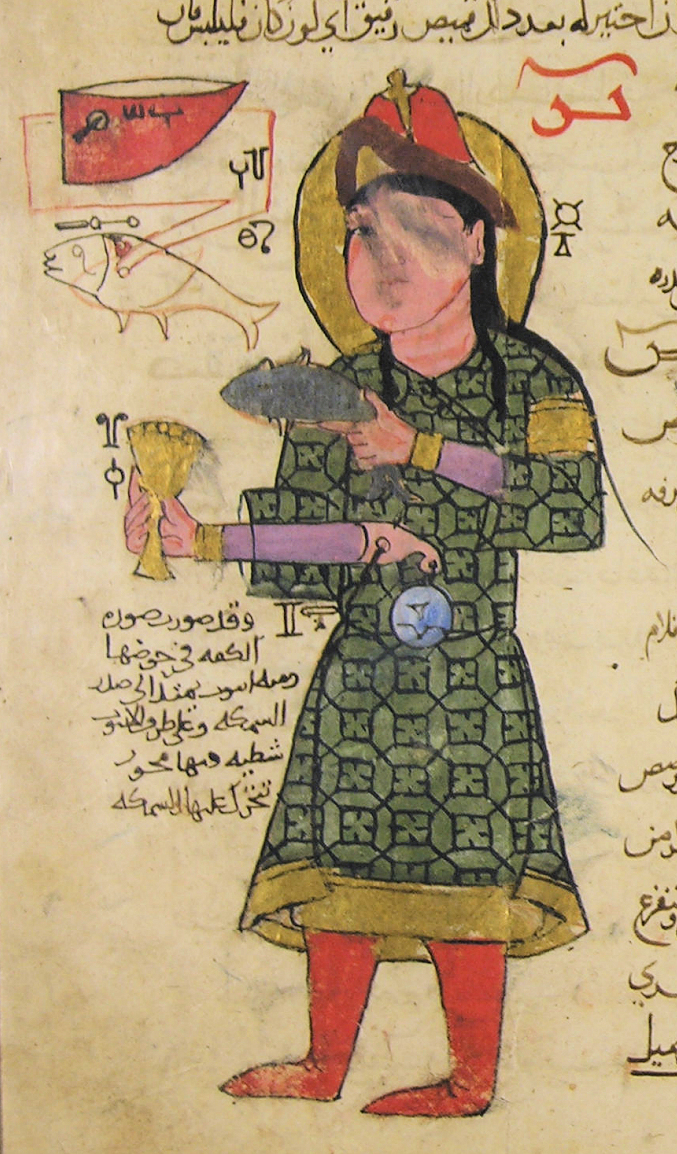
The Muslim polymath Badīʿ az-Zaman Abu l-ʿIzz ibn Ismāʿīl ibn ar-Razāz al-Jazarī (1136–1206) invented dozens of objects, including an elephant clock in which a large timing mechanism in the shape of an elephant indicated every half hour using cascading water and various parts. Al Jazarihat wrote “The Book of Knowledge of Ingenious Mechanical Devices” in Arabic — he is considered to be the inventor of robotics. I love this image above, dated 1206. It shows a mechanical “male servant” beautifully robed in a green patterned frock with purple sleeves and a golden cup in one hand and a fish in the other. The red leggings match his hat. From what I can understand, this robot is meant to serve future guests. From what I can also understand about the future of robotics, I can only hope someone as cool looking as him will be feeding me when I am very old.
Quote of the Day
“We all do what we can
So we can do just one more thing
We can all be free
Maybe not in words
Maybe not with a look
But with your mind.”
— Chan Marshall / Cat Power (TypeQuote)
Thanks for reading and reading this far. If you would like to subscribe to Dear Designer, dear designer, please please do:
And don’t forget about Wikipedia. Click the heart button or leave a comment. I’ll donate $1 for every heart or comment on this week’s post (up to CA$100.00) to Wikipedia Canada.