
Dear Designer,
I’ve been thinking about this topic for a long while now and I would like to get it off my chest so that I can start to write a bit more about issues directly related to the mental, physical and spiritual health of designers, which is actually close to my heart. It’s not that I don’t like writing about the economic and new political challenges that we designers are facing and will face — rather, I am hoping to write slightly more evergreen posts that will stand the test of our times and perhaps help those designers who are struggling to find their way in the world. There is a chance this piece does a little of both.
That’s the prologue.
It used to be that there was a fairly simple division of design economy labor in North America. In brief, there were independent designers, small studios and larger agencies. This model evolved in the 1980s when more designers were graduating from superb and highly specialized design schools (Parsons, RISD, OCAD) and brands of all sizes were recognizing the immediate and long-term business benefits of visual positioning (product branding and institutional identity development). It also coincided with the birth of the desktop publishing revolution, when designers were no longer tied to drafting tables, rulers, Linotype machines and typewriters.
Instead, designers could untether from the sprawling concrete physical workplaces in which they once toiled. In the 1980s, the Mad Men era of designers, copywriters and art directors working in major agencies in major cities broke apart into many novel pieces. For the first time since the 19th century, designers (née artists) could once again support themselves financially as independent practitioners, working as freelancers (1980s parlance), subcontractors (1990s), solopreneuers (2000s) and contractors (today).
As I mentioned in the last week’s post, there are some 240,000 graphic designers living and working in North America these days. They work for themselves or for studios, agencies or in-house. Ignoring the latter category, designers today typically take on the role of consultants. They work meticulously and methodically with a range of clients from government to retailers to nonprofits and corporations. Sometimes they solve visual problems related to brand strategy or presentation of ideas or they organize complex ideas and interests. Other times, they are busy creating digital products that online visitors use to find ideas and interests, communicate with others or build community.
Since the pandemic, this three-tier system has continued. As of January 2025, there are about 18,524 design agencies operating in the United States, a 2% increase from 2023; further, the are about 122,000 freelance designers in the U.S. today.
But things are changing, quickly
In the meantime, design and digital services took a tremendous hit in 2024. The end of Covid-related funding, higher interest rates, the rise of AI and template design, and the uncertainty of national political outcomes put a freeze on spending, a fate that I and many others saw personally. Last year was a difficult, complicated, and often depressing one that saw layoffs, cutbacks, and a general retrenchment in interest among organizations in design and design consult. So far, 2025 has seen a resurgence in organizational spending but, like many in the design field, we are bracing for more disruption.
Here is how I think things may change for us, dear designer. I believe that there are five trends that will shape what we do, what kinds of work we look for, what kinds of jobs we hold, and where we physically sit as graphic designers over the next two to five years.
- AI design. Without a doubt, tools like Midjourney, Adobe Firefly, ChatGPT/DALL-E and others are moving fast. A few weeks ago, we saw the re-release of Figma’s generative AI tool that produces what a very young junior designer might create out of school. In other words, it’s not bad. But it ain’t great, either. I have experimented with a number of tools like Ideogram.ai to produce logos and visual objects. They are highly imperfect and currently difficult to refine — and they don’t speak to me in any emotional way — but these tools work. The typography is interesting but uninviting. The concepts are cool but clunky. The photography is realistic but also slightly revolting; we are submitting ourselves to sitting in the uncanny valley of machine made majesty. AI will continue to get increasingly sophisticated in its presentation of visual reality but I believe it will continue to lack the finesse, humanity and elegance that makes superb and subtle artistry so truly valuable. I could be entirely wrong about this — but have a look at some of the work on Ideogram and let me know what you think.
- Commoditized design. Because I have so far yet to subscribe to YouTube’s ad-free experience (out of pure principle), I am constantly subjected to WIX studio ads. It’s good and also gross marketing. The latest ads showed how designers can now take a finished design in Figma and convert it to a WIX website replete with pre-built CMS. It does seem compelling. If you combine this AI- built experience with the realities of so many excellent templates out there on Squarespace, Cargo, Readymade, Carbonmade, Shopify and other web platforms, it is an embarrassment of templated design riches. A small business will no longer pay tens of thousands of dollars for a site that will last for a year or two at most. Commoditization, or the process in which lowest price seeks the highest value, is inherent to the infrastructure of the digital economy. Design, at least as a commercial practice, will continue to suffer from this construct.
- Customized design. Design, positioned as a more traditional artistic practice, however, will remain and differentiate. Even under the aegis of AI and commoditization, customized design — the creation of unique visual objects that solve communications problems or create new ideational challenges — will last, at least for a while. Having an aesthetically-focused design practice — one that truly offers a unique visual and technical approach — will continue to attract individuals and organizations that seek to be truly different and differentiated. Work that is hand-made, odd, magisterial or mysterious, and that is forged from a deep understanding of typography, subject matter, and design systems, will continue to be valued and valuable.
- Niched design. Most of us have heard the wise silliness of there being “riches in the niches.” Over the past 20 years, agencies that have specialized in a given industry have reaped the benefits. Folks like Blair Enns, who I admire tremendously and who has taught me so much about the business of design, have long argued that the tighter the market positioning, the more opportunities there are to leverage expertise. In other words, if you are an agency focused on newsletter marketing for athletic shoe brands, there is a strong likelihood that companies like Nike and Reebok will want to learn about those skills. (Another example: At Manoverboard and now Mangrove, our focus is on ethically creating open source websites for organizations creating transformational social change. Our niched design approach is just tight enough to warrant consistent interest among nonprofits.)
- Consultative design. There will be an increased need for art direction, design research and data-driven or user-focused UX consulting. All of these will tap into AI for ideation, data, and conceptualization, and it will be driven by the independent knowledge of the design practitioner. In other words, designers who consult as digital art directors will find more willing clients who seek to visually or otherwise transform their organizations. These art directors will require more refined managerial and research-related skillsets but they will also be able to command commensurate compensation. There will also be a need for consultants to help teams manage projects, to help designers face real world challenges, to help build new brand systems, and to launder for other art directors. (Just seeing if you’re still reading.)
Five trends meeting five predictions
The resulting effects will be something like this.
- Low-skilled freelance work will start to disappear — almost entirely. People and organizations that need free or cheap design will be able to get it free and cheap. It will look decent. It will work. Most design will be made this way.
- Mid-sized design studios and agencies will forge forward. There will continue to be a need for design services that craft and cater. They will be positioned tightly around subjects matter expertise, design excellence and considered client care.
- Independent designers will become miniature studios. One-person shops will thrive if they understand the tools and create value for committed clients. The work will need to look and feel very different. These designers will become artists again.
- Large agencies will shrink. The need for major agencies will diminish. Their overhead, with large offices and dozens of diverse experts, will no longer be needed. Large brands will seek smaller artistic outlets and deep expertise.
- In-house design teams will also shrink. Corporations with in-house design teams will not want to pay for generalized design and the training and technical upkeep of designers and developers. Instead, they will hire out and build teams that push new ideas and practical products.
And now the catch and caveat. Some of the above is based on actual research but a lot of my conjecture is built on good old anecdotal evidence such as personal conversations and lots of reading and cogitating. AI, in particular, has the power to distintermediate entire industries, including design. We may find that design and designers go the way of the horse and the buggy driver. But I don’t think so.
So… please don’t leave your design job or start a new career based on my tea leaves alone. And don’t quit school or tell your family that you’re washed up. School is wonderful and so are you.
Keep at it. Work harder and learn more than you ever have in the past. Study. Remember that graphic design is as much an art as it is a professional career. Be the artist that you are; your one mission is to push forward at all costs.
Yours,

Image of the week
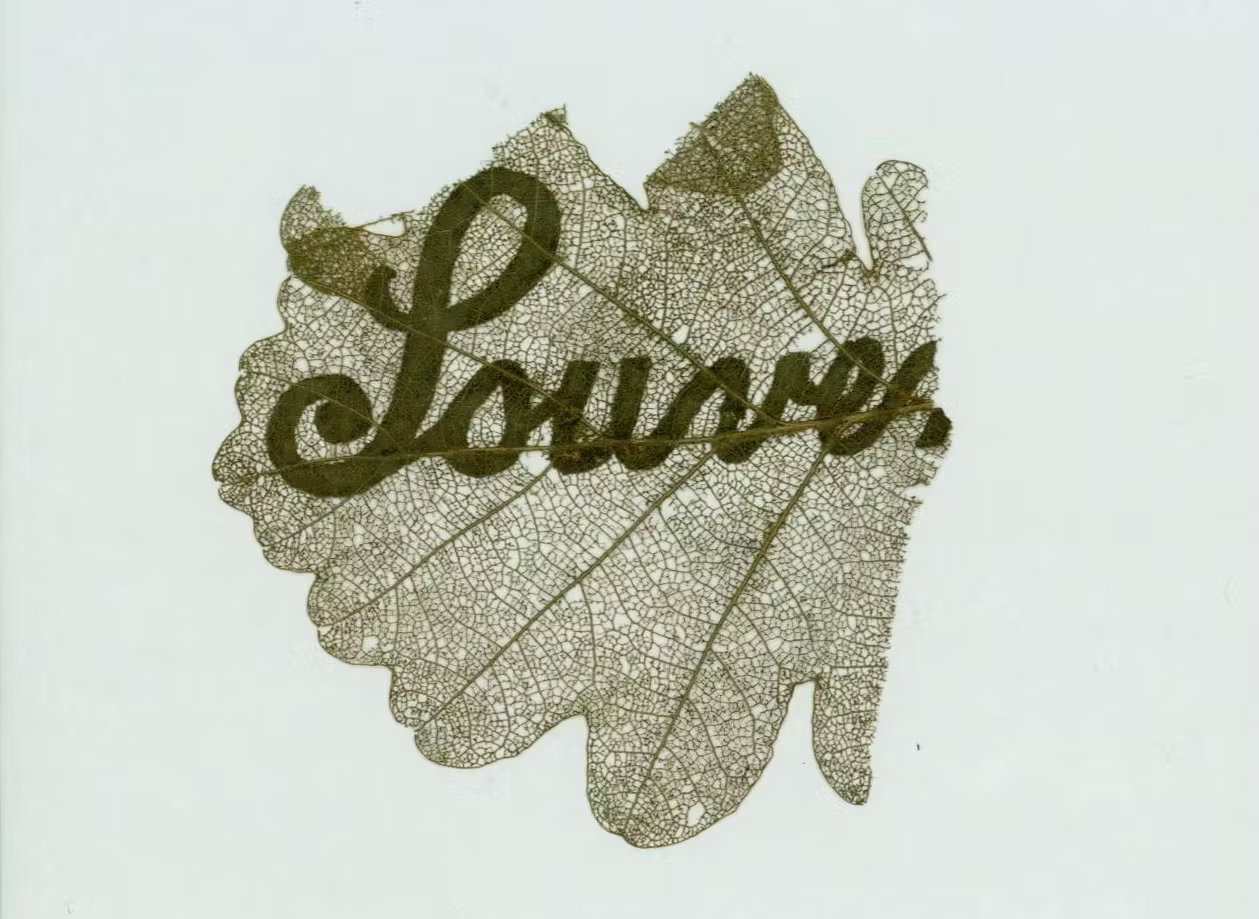
In that most brutal of all brutal wars, men in trenches made small mementos to pass long lengths of time while awaiting their immediate fates. In those foxholes, soldiers on all sides whittled objects out of wood, crafted letter openers out of steel, or, like Hippolyte Hodeau, used relief carving to remember the names of his daughters and others important to him. Over 100 years later, these fragile works of trench art somehow still exist. This leaf speaks deeply to me, with its rounded, thick and undulating handwriting, observing and ignoring the curvature of veins and vessels. World War I, which my grandfather once fought in as an American soldier, shaped everything about our last century, not least of which causing 40 million casualties. We are lucky to be alive and lucky to be alive to all that is human-made.
Quote of the week
…To find in the fishes, the creatures, the air
Been hangin' around
God loves ya, but what could he do?
Yeah, wha wha wha wha wha what could he do?
Passion and a lovin' suggestion gonna send ya
Into somebody's icy arms and now
Graphics will do the deal justice
It's a can't lose
Only two times or three or four or more…
~ Speak, See, Remember (1999), Steven Malkmus, Pavement
Thank you for reading, dear designer. I would so appreciate if you could share this piece with someone today. Here is the smallest of buttons:
If Dear Designer was forwarded to you, you can get your very own subscription here. This newsletter is free and so are you.